
How to Trust Yourself Again (When Overthinking, Self-Doubt, And Anxiety Have Taken Over Your Inner Voice)
The following is a guide on how to trust yourself again when overthinking, self-doubt, and anxiety have made your internal guidance & intuition feel unreliable.
It explains why self-trust breaks down, why intuition gets confused with anxiety, and how to rebuild a stable relationship with yourself through patterns (not perfection!)
If you find yourself second-guessing decisions, outsourcing your intuition or decision making, or overanalyzing everything until nothing feels clear anymore, this is for you!

Overthinking and chronic self-awareness can feel like a curse. Like endless background noise that you can never turns off. Decisions, conversations, emotional predictions, imagined outcomes, past mistakes, future scenarios... All running at the same time while you try to figure out something as simple as what you actually want!
Even small choices begin to feel loaded. Not because they’re important to “get right”, but because anytime you need to check in with yourself your nervous system starts blaring high alert danger sirens!
So you delay…. analyze…. ask for reassurance… and generally try to think your way into safety.
But through this process, you slowly begin to erode trust in your own internal signals. And this builds up over time to make self-trust feel next to impossible.
WHAT SELF-TRUST ACTUALLY IS
Self-trust is the ability to stay connected and listening to your own internal signals , even while you are uncertain.
It is NOT:
always knowing what to do
always feeling confident
always making the “right” choice
always being emotionally certain
Self-trust IS:
staying in relationship with yourself, even when you are unsure!
This distinction matters a lot, because most people lose self-trust by chasing certainty that doesn;t actually exist
WHY YOU STOP TRUSTING YOURSELF
Self-trust doesn’t usually collapse in one moment, it erodes through repetition and neglect. This can look like overriding your feelings consistently enought that they start to feel unreliable.
You second-guess yourself enough times that your own perception starts to feel less valid than external input or outsourcing your authority to outsiders.
After a while of repeating this enough times, your internal signal starts to be dismissed as background noise.
Over time, your system adapts and your logic breain begins to take the lead with overthinking, overanalyzing, and checkin in with anything outside yourself before CHOOSING.
WHY OVERTHINKING IS OFTEN A SELF-TRUST ISSUE
Overthinking is often treated like anxiety or indecision, but underneath it is often something simpler. A lack of trust in your ability to handle consequences or a fear of “getting it wrong”.
So your mind tries to solve uncertainty by thinking harder, trying to predict everything to avoid regret, overanalyzing to avoid emotional risk, and thinking thinking thinking to avoid being wrong!
Unfortunately, this is not how it works! Self-trust doesn’t mean always getting it “right” or avoiding emotional upset and sad times. Self-trust means listening to your inner guidance and seeing where it takes you. All roads are hard and full of struggles, that’s the way life is.
BUT a life where you can maintain a relationship with the quiet signals within will always be your best guide.
CHECK OUT WEAVING CHAOS- A MONTHLY CREATIVE SHADOW WORK SPACE FOR SELF-TRUST, INTUITIVE DEVELOPMENT, AND UNSHAKABLE CONFIDENCE
INTUITION VS ANXIETY (WHY THEY GET CONFUSED)
Intuition and anxiety both show up in the body and are “felt” experiences.
Both can feel urgent.
Both can feel emotionally charged.
Both can feel like they require IMMEDIATE attention.
But they definitely move and are experienced differently.
Anxiety expands and spreads. It creates branching scenarios, fear loops, and mental escalation.
Intuition has a more “narrowing” energy. It typically does not multiply itself or feel like a spreading stain of chaos. It tends to remain “steady” feeling, even if it is intense it will feel more “stable”.
When someone has lived in chronic stress or emotional hypervigilance, anxiety can start to feel like intuition because it is louder and makes all body systems activate. This is one of the main reasons self-trust becomes unclear, particularily to those with anxiety and trauma and who have experienced the pain of taking what they may feel is the “wrong” path.
THE REAL REASON YOU DON’T TRUST YOURSELF
In many cases, a lack of self-trust it is not a thinking problem. In fact, it is pretty constant in the chronically self-aware and overthinking types!
What it is is a disconnection and nervous system pattern.
Your system learns:
uncertainty is unsafe
mistakes have high emotional cost
feelings are unreliable
other people’s perspectives are more accurate
So your subconscious system adapts by increasing attempts for control through thinking.
The problem is that thinking cannot regulate emotional safety long term.
So you stay stuck in analysis loops that never fully resolve.
HOW TO START TRUSTING YOURSELF AGAIN
Self-trust is rebuilt through behavioral evidence and ACTION-not more insight, thought loops, or analysis!
1. Stop treating every thought as TRUE/DIRECTIVE
Thoughts are not instructions. They are just… thoughts! Some are fear responses. Some are memory. Some are projections.
I heard it once explained like this- thoughts are like cars on the highway, you don’t have to hop into each one!
2. Notice where you abandon yourself
All behavioral work and healing can be overcome in the early stages by tackling AWARENESS. Becoming more present allows you to pay attention to moments where you:
override or gaslight your feelings immediately
go out seeking external permission
ignore discomfort to stay comfortable
delay decisions until you feel certain
These are the moments self-trust is either rebuilt or continues to be eroded.
3. Make smaller decisions without overprocessing them
Self-trust grows through repetition and action. So start making decisions by listening to yourself, and then KEEP doing that. Start choosing and see that you can survive the outcome.
Train yourself to stop seeking perfect certainty.
4. Learn your patterns instead of judging your reactions
Your overthinking is not random, it follows patterns. Once you understand the pattern, you stop experiencing yourself as chaotic and start seeing the logic in your responses.
This is where shadow work and depth psychology becomes useful in the work I do with people, because it helps map the subconscious structure underneath behavior rather than just managing symptoms.
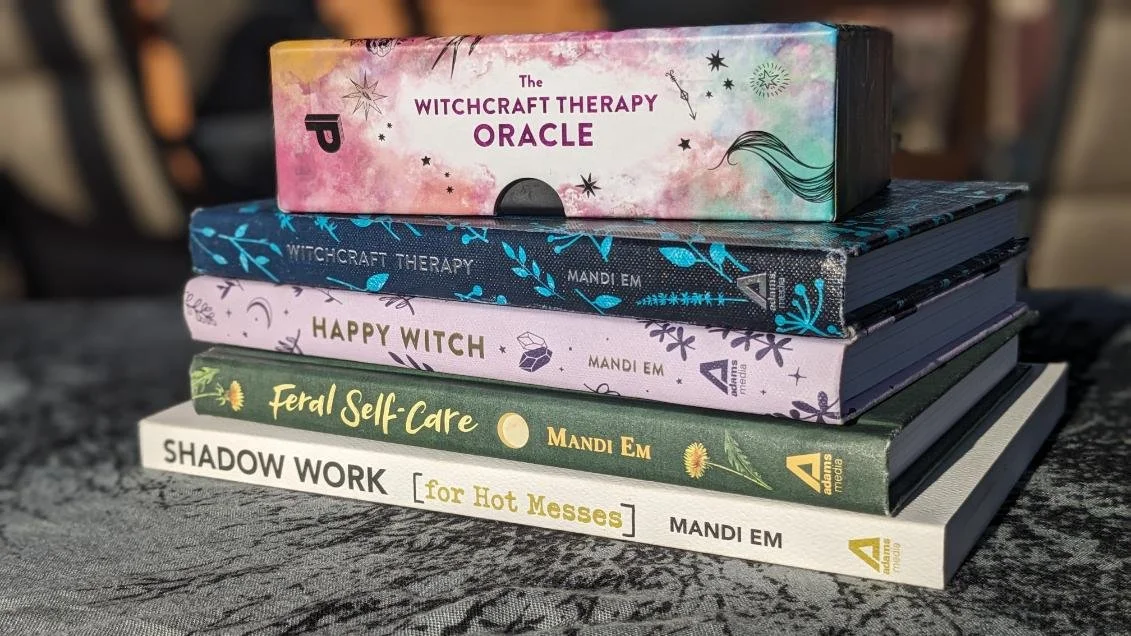
Check out my books on Witchy Wellness and Empowered Healing
5. Allow uncertainty to exist without trying to solve it
Most self-trust issues come from needing certainty before taking action. But certainty is not something you reach first, it is something you build through experience!
WHY CHANGE FEELS HARD EVEN WHEN YOU UNDERSTAND IT
Your nervous system does not change through logic, thinking, and understanding alone.
Instead, it changes through repetition and safety over time. Even when you logically understand your patterns, your body may still default to old strategies like overthinking or self-doubt because they are familiar. Paritcularily if you are not “present” in awareness and operating on autopilot (the default zone for most of us most of the time!)
Familiar doesn’t always mean healthy though. It just means what is “known”.
This is why self-trust often feels like a back-and-forth chaotic process instead of a linear one.
WHERE SYMBOLIC WORK FITS
Internal experiences are not purely logical. They show up as emotion, imagery, repetition, and pattern.
This is where practices like shadow work, journaling, therapeutic art, and symbolic systems such as tarot or chaos magic (understood psychologically) can help.
These aren’t prediction tools when approaching things through a symbol/depth work lens- instead they are translation tools that helps you access internal material that does not organize itself into language easily.
SELF-TRUST IS NOT THE ABSENCE OF CHAOS!
A self-trusting person still:
feels uncertainty
experiences anxiety sometimes
changes their mind
makes imperfect choices
slips into overthinking
We are not looking for “emotional perfection” because that just DOESN’T EXIST!!!
What a self-trusting person cultivates which is different is:
They do not abandon themselves, their internal signals, their intuition, and their channels when they are uncertain.
If you’re ready to unlock your next level of self trust & Intuitive development through chaos magic, depth psychology and creative shadow work join OUR weAving chaos community!